
🎄 Festive Rush - Deliveries might take a bit longer. We appreciate your patience.
Festive Period 2025
Cut-Off Times


Choosing between air freight and sea freight has become more difficult as ongoing route disruptions reshape global supply chains. Freightos reported in April 2026 that South Asia-Europe air freight rates hit US$5.15/kg, double pre-conflict levels, while Southeast Asia-Europe rates stayed 60% above pre-war levels as Middle East disruptions continued to push cargo into air networks.
This guide compares transit times, cost volatility, capacity, and routing flexibility across both modes. It shows when air freight is worth the premium, when sea freight still makes sense, and how to compare both before booking.
Get a quote to compare air freight and sea freight rates for your shipment.
Get a Quote NowUnder normal trading conditions, the choice between air freight and sea freight is straightforward. Sea freight costs significantly less per kilogram but takes weeks longer. Air freight costs more but delivers cargo in days. Most businesses build their supply chains around this trade-off and rarely revisit it.
Route disruptions break that logic. When maritime chokepoints become unreliable, sea freight loses the one thing that justified its lower cost: predictability. The gap between air freight vs sea freight during route disruptions narrows sharply, because a delayed or cancelled sailing can wipe out the savings sea freight normally offers.
Two chokepoints are currently reshaping freight decisions for Australian importers. In the Red Sea, vessel diversions remain widespread as carriers continue avoiding security risks and routing services around the Cape of Good Hope, adding approximately 10 to 14 days to affected voyages.
At the same time, Kpler reports continuing disruption linked to the Strait of Hormuz, where regional instability has altered vessel movements and reduced routing certainty. The operational consequences include blank sailings, longer transit schedules, equipment imbalances, and congestion at major transhipment hubs.
For Australian businesses shipping cargo on Asia-Europe and Middle East trade lanes, the traditional cost advantage of sea freight is no longer the only factor influencing mode selection.
The table below compares how air freight and sea freight behave under active disruption conditions, not under normal shipping conditions.
Air freight absorbs demand fastest when ocean capacity tightens. Freightos Air Index data showed Southeast Asia-to-Europe rates rose more than 6% in a single week during recent demand spikes.
Dubai and Singapore, both transit hubs on Australian import routes, reported higher cargo throughput as carriers rerouted displaced ocean freight into air networks.
Ocean freight is absorbing the same disruption, with its own cost consequences. Drewry recorded 136 cancelled sailings across major east-west trades in one reporting period, and Cape of Good Hope diversions continue adding 10 to 14 days to affected Asia-Australia voyages.
Carriers have used the disruption to justify rate action as well. CMA CGM has applied Gulf surcharges of up to US$3,000 per forty-foot equivalent unit (FEU) on selected cargo.
With both modes carrying elevated cost and delay, cargo value becomes the deciding factor.
A shipment of electronics or an urgent spare part can absorb the air freight premium and still come out ahead once a 10 to 14-day sea delay is priced in. A pallet of furniture or low-margin retail stock rarely clears that threshold. The air premium per kilogram exceeds the value of the goods.
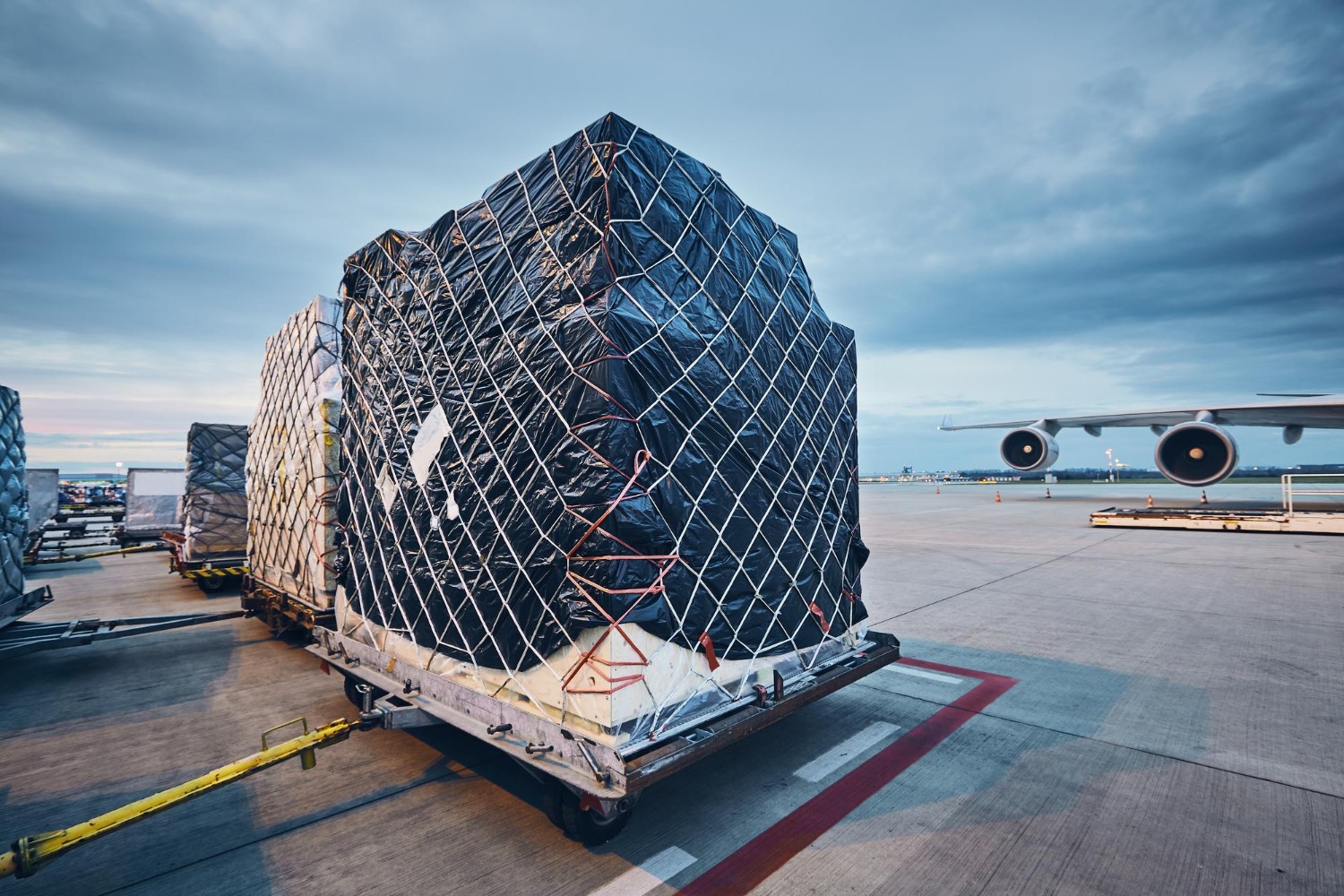
The bottom line is, not every shipment fits either category. Sea-air freight is built for the cargo in between. It ships by ocean to a regional hub, then transfers to air for the final leg to its destination.
Several logistics providers now offer sea-air solutions that combine ocean freight with a final air freight leg. Maersk currently runs a dedicated Sea-Air network built for the Middle East disruption, routing cargo through gateway hubs such as Salalah and Dubai before connecting into its air freight services.
It falls between pure ocean and pure air on cost and transit time, and it's the option Australian importers can turn to when a delayed sailing and full air freight costs are both unworkable.
The following situations point towards air freight during an active disruption:
This aligns with inventory segmentation guidance used by global logistics providers. According to Maersk's supply chain planning guidance, freight mode decisions should be based on value density, urgency, and stockout risk rather than shipment size alone.
Sea freight remains the better financial decision in several common scenarios, even with extended transit times:
For Australian importers running regular LCL or FCL shipments, carrying extra safety stock during a disruption usually costs less than shifting large, low-margin cargo volumes to air freight.
Once you've worked through the framework above, the next step is comparing rates for your own shipment.
Compare air freight, LCL sea freight, and FCL sea freight rates across multiple carriers through a single Couriers & Freight quote, without contacting each carrier individually.
Get a quote for your international shipment today.
Get a quote to compare air freight and sea freight rates for your shipment.
Get a Quote Now


MHP

No Surcharge*

$16.50
$14
$15.50
$0
$15.50
$14.75
$0
$0
$0
$0
MHP Large Item
No Surcharge*
$16.50
$75
$62
$62
$60.10
$14.75
$0
$0
$0
$0
Residential Pickup
No Surcharge*
$6
$0
$9
--
$9
$10.60
$0
$0
$0
$38.50
Reidential pick up 30-99kgs
No Surcharge*
$63
$0
$9
$0
$9
$74.15
$20
Won't carry
Won't carry
$38.50
Residential pick up 100kgs+
No Surcharge*
$198
$0
$9
$0
$9
$158.87
$50
Won't carry
Won't carry
$38.50
Residential Delivery up to 29kgs
No Surcharge*
$6
$0
$9
--
$9.00
$10.60
$0
$0
$0
$38.50
Residential Delivery up 30-99kgs
No Surcharge*
$63
$0
$9
$0
$9
$74.15
$20
Won't carry
Won't carry
$38.50
Residential Delivery 100kgs+
No Surcharge*
$198
$0
$9
--
$9
$158.57
$50
Won't carry
Won't carry
$38.50
Tail Lift Pick up 50-99kgs Sydney / Melbourne
No Surcharge*
$45
$50-$250
$88
$88
$88
$44.07
$120
Won't carry
Won't carry
$61.50
Tail Lift Pick up 100-299kgs Sydney / Melbourne
No Surcharge*
$85
$50-$250
$88
$88
$88
$44.07
$120
Won't carry
Won't carry
$61.50
Tail Lift Pick up 300-499kgs Sydney / Melbourne
No Surcharge*
$120
$50-$250
$88
$88
$88
$44.07
$120
Won't carry
Won't carry
$61.50
Tail Lift Pick up 500kgs + Sydney / Melbourne
No Surcharge*
$250
$50-$250
$88
$88
$88
$44.07
$120
Won't carry
Won't carry
$61.50
Tail Lift Delivery 50-99kgs Sydney / Melbourne
No Surcharge*
$45
$50-$250
$88
$88
$88
$44.07
$120
Won't carry
Won't carry
$61.50
Tail Lift Delivery 100-299kgs Sydney / Melbourne
No Surcharge*
$85
$50-$250
$88
$88
$88
$44.07
$120
Won't carry
Won't carry
$61.50
Tail Lift Delivery300-499kgs Sydney / Melbourne
No Surcharge*
$120
$50-$250
$88
$88
$88
$44.07
$120
Won't carry
Won't carry
$61.50
Tail Lift Delivery 500kgs + Sydney / Melbourne
No Surcharge*
$250
$50-$250
$88
$88
$88
$44.07
$120
Won't carry
Won't carry
$61.50
Dead weight over 32KGS carton freight
No Surcharge*
$16.50
$75
$70
$70
$70
$14.75
$0
Won't carry
Won't carry
$0
Oversize Surcharge 1.20 - 1.54
No Surcharge*
--
$0
$0
$0
$0
$5.40
$10
$15
Won't carry
$0
Oversize Surcharge 1.55 - 1.85
No Surcharge*
$17
$20
$0
$0
$0
$11.93
$10
$15
Won't carry
$0
Oversize Surcharge 1.86 - 2.20
No Surcharge*
$37
$40
$0
$0
$0
$11.93
$10
Won't carry
Won't carry
$0
Pallet Surcharge
No Surcharge*
--
$0
$0
$0
$0
$0
$0
Won't carry
Won't carry
$0
Hand Unload Fee Carton
No Surcharge*
--
$0
$70
$70
$70
$47
$0
Won't carry
Won't carry
$61.50
Western Australia Regional Surcharge
No Surcharge*
%10
$0
$0
$0
$0
$0
$0
$0
$0
$0
*Surcharges may apply to areas/deimensions not listed
**Prices correct of 16th September 2024

Click to start shipping in less than 60 seconds