
🎄 Festive Rush - Deliveries might take a bit longer. We appreciate your patience.
Festive Period 2025
Cut-Off Times

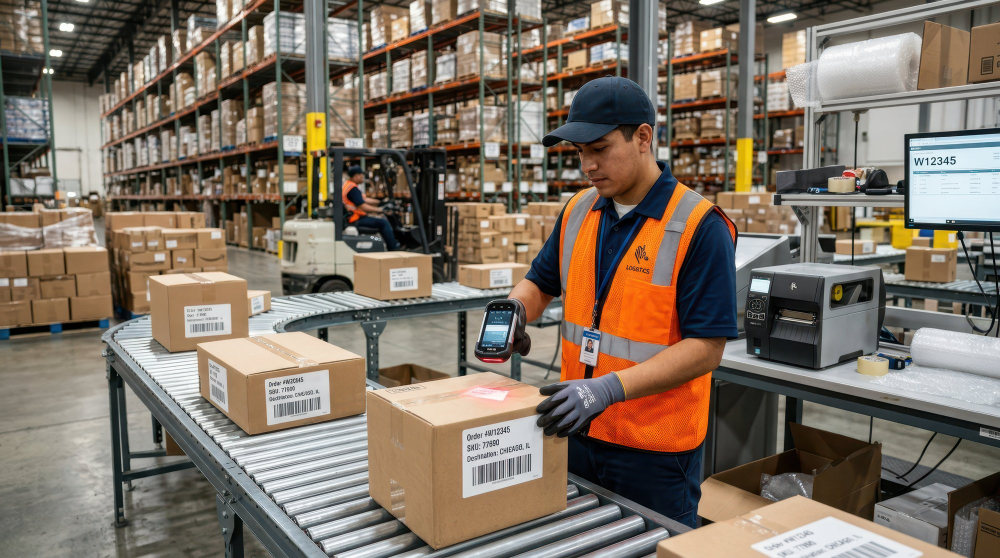
Australian household retail spending rose 4.8% year on year in December 2025, according to ABS figures released in February 2026. Sellers did not all benefit equally, with some over-ordering and discounting prices and others under-ordering and running out of stock.
Effective seasonal inventory management helps avoid both problems and keeps cash from sitting in unsold products. This guide outlines seven strategies sellers can apply before their next busy season.
Get a quote to store your seasonal stock and dispatch your orders.
Get a Quote NowSeasonal inventory management matches stock levels, supplier orders and warehouse capacity to predictable changes in customer demand.
Arrange warehouse and fulfilment with Couriers & Freight to support seasonal stock storage and order dispatch.
These seven strategies follow the order a season runs in, from before the peak to after it.
Anticipation inventory is stock built ahead of forecast peak demand. Start with sales from comparable past seasons, separate promotional sales from baseline sales, then set a build quantity for each stock-keeping unit (SKU) against the season’s start date.
For example, an online retailer in Melbourne whose Christmas gift box sold 1,500 units between 1 November and 24 December last year.
Of those, 400 sold in its Black Friday weekend promotion, leaving 1,100 baseline sales over 54 days, or about 20 a day.
The first 33 days averaged 18 a day, and the last 21 averaged 24, so exponential smoothing, which weights recent weeks more heavily than older ones, sets this year’s baseline at about 22 per day.
Across 54 days, that is roughly 1,200 boxes, and the 400-box promotional allowance brings the build quantity to about 1,600. Ordering on baseline alone would leave Black Friday weekend about 400 boxes short.
CommBank iQ found Black Friday 2025 fortnight spending 19.5% above normal, which is why inventory forecasting has to treat promotions as their own line.
Recalculate safety inventory every season. It is stock held against demand or lead-time variation, kept separate from the stock the forecast expects to sell.
Base it on the supplier’s actual lead time from the last order, not the quoted one. The retailer’s supplier in China quotes 14 days from order to goods ready for shipping, but the last order took 21.
At 22 boxes a day, that extra week is 154 boxes, so the retailer holds about 150 boxes of buffer stock on top of the 1,600 it expects to sell.
The Black Friday spike is already in the 400-box promotional allowance, so the buffer only has to cover a late order. A buffer sized on the quoted 14 days has no allowance for that week, and a late order leaves the retailer about 150 boxes short in early November.
Pro Tip: It is best to double your order to 300 boxes to be safe, and it ties up $5,400 at a landed cost (supplier price plus freight and duty) of $18 a box, and whatever stays unsold is still in the warehouse in January.
Pipeline inventory is stock in transit between supplier and warehouse.
Work backwards from the date stock must be ready to pick. The retailer needs its 1,750 boxes, shipped in one 20-foot container, ready on 1 November.
Receiving and put-away take 3 days, and port and customs clearance take 5. Sea freight from China takes 30 days in this example, within the usual 20 to 40 days and against 3 to 7 by air, and the supplier needs 21 days to produce.
Counting back from 1 November, that is 59 days, so the order goes to the supplier on 3 September.
An order placed two weeks late, on 17 September, lands on 15 November, and 14 days of baseline sales at 22 a day, about 300 boxes, are gone.
For any order that overlaps the 2027 Chinese New Year holiday (5 to 12 February), add those eight days to the production figure. The Christmas cut-off dates set the last day an order can ship for delivery before 25 December.
Shorten replenishment cycles during peak trading, then return to the normal cadence after Boxing Day. Cycle inventory is stock that runs down between replenishment orders. Peak top-ups come from a domestic supplier, because an imported order takes 59 days to arrive.
A domestic supplier’s lead time runs from order to delivery, so a quoted five days is the whole wait. Calculate the reorder point by multiplying daily sales by that lead time and adding safety inventory.
For example: 20 gift boxes a day × five days' lead time + 30 boxes of safety inventory = 130 boxes.
If the supplier delivers in eight days, not five, the retailer is 66 boxes short. Economic order quantity (EOQ) is the order size at which ordering and storage costs together are lowest, so each top-up is sized to that figure and not to a round number.

Store seasonal products in a dedicated zone between receiving and dispatch, separate from year-round stock.
Decoupling inventory is a buffer between two stages, so a surge or delay in one does not stall the other.
In practice, a container unpacked at receiving goes straight into the seasonal zone, and pickers draw from that zone and not from the main racking. A late truck at the dock then does not halt packing, and a rush of orders does not empty the receiving bay.
Match labour to the same two peaks, with extra people on the dock in the weeks stock arrives and extra pickers and packers from Black Friday to the last Christmas cut-off. Clear the zone back to bulk storage after the peak. Businesses short of space can assess third-party logistics (3PL) warehousing.
Dead stock is inventory that remains unsold because demand has fallen away or the product is no longer commercially viable. A tiered markdown cuts the price in steps, each tied to a date, so the price falls only as fast as sales slow.
Demand drops after Boxing Day on 26 December 2026, so the first tier starts that week. Later tiers follow at fixed review dates, for example, 20% off in the week after Boxing Day and 40% two weeks later, then clearance pricing.
Each tier deepens only if the previous one left stock unsold. Bundle slow Christmas accessories, such as ribbon and gift tags, with a top-selling gift box so the best seller carries the discount. Warehouses charge for pallet space by the week, so every week an unsold pallet stays adds cost and uses space the next range needs.
Run a physical stocktake first to reconcile records against shelf stock. Then record, for each SKU, forecast units against units sold, the days it was out of stock, and the supplier’s quoted lead time against its actual one.
Units still unsold on 31 January set next season’s markdown schedule. Without this record, the retailer repeats the same errors next Christmas.
Once its seasonal inventory management plan has been forecast, sized and scheduled, the business needs space to hold stock and capacity to dispatch orders.
Couriers & Freight provides warehouse and fulfilment services for e-commerce businesses selling through their own website, Shopify, eBay, Etsy and Amazon.
Book warehouse and fulfilment with Couriers & Freight before peak trading begins.
Get a quote to store your seasonal stock and dispatch your orders.
Get a Quote Now


MHP

No Surcharge*

$16.50
$14
$15.50
$0
$15.50
$14.75
$0
$0
$0
$0
MHP Large Item
No Surcharge*
$16.50
$75
$62
$62
$60.10
$14.75
$0
$0
$0
$0
Residential Pickup
No Surcharge*
$6
$0
$9
--
$9
$10.60
$0
$0
$0
$38.50
Reidential pick up 30-99kgs
No Surcharge*
$63
$0
$9
$0
$9
$74.15
$20
Won't carry
Won't carry
$38.50
Residential pick up 100kgs+
No Surcharge*
$198
$0
$9
$0
$9
$158.87
$50
Won't carry
Won't carry
$38.50
Residential Delivery up to 29kgs
No Surcharge*
$6
$0
$9
--
$9.00
$10.60
$0
$0
$0
$38.50
Residential Delivery up 30-99kgs
No Surcharge*
$63
$0
$9
$0
$9
$74.15
$20
Won't carry
Won't carry
$38.50
Residential Delivery 100kgs+
No Surcharge*
$198
$0
$9
--
$9
$158.57
$50
Won't carry
Won't carry
$38.50
Tail Lift Pick up 50-99kgs Sydney / Melbourne
No Surcharge*
$45
$50-$250
$88
$88
$88
$44.07
$120
Won't carry
Won't carry
$61.50
Tail Lift Pick up 100-299kgs Sydney / Melbourne
No Surcharge*
$85
$50-$250
$88
$88
$88
$44.07
$120
Won't carry
Won't carry
$61.50
Tail Lift Pick up 300-499kgs Sydney / Melbourne
No Surcharge*
$120
$50-$250
$88
$88
$88
$44.07
$120
Won't carry
Won't carry
$61.50
Tail Lift Pick up 500kgs + Sydney / Melbourne
No Surcharge*
$250
$50-$250
$88
$88
$88
$44.07
$120
Won't carry
Won't carry
$61.50
Tail Lift Delivery 50-99kgs Sydney / Melbourne
No Surcharge*
$45
$50-$250
$88
$88
$88
$44.07
$120
Won't carry
Won't carry
$61.50
Tail Lift Delivery 100-299kgs Sydney / Melbourne
No Surcharge*
$85
$50-$250
$88
$88
$88
$44.07
$120
Won't carry
Won't carry
$61.50
Tail Lift Delivery300-499kgs Sydney / Melbourne
No Surcharge*
$120
$50-$250
$88
$88
$88
$44.07
$120
Won't carry
Won't carry
$61.50
Tail Lift Delivery 500kgs + Sydney / Melbourne
No Surcharge*
$250
$50-$250
$88
$88
$88
$44.07
$120
Won't carry
Won't carry
$61.50
Dead weight over 32KGS carton freight
No Surcharge*
$16.50
$75
$70
$70
$70
$14.75
$0
Won't carry
Won't carry
$0
Oversize Surcharge 1.20 - 1.54
No Surcharge*
--
$0
$0
$0
$0
$5.40
$10
$15
Won't carry
$0
Oversize Surcharge 1.55 - 1.85
No Surcharge*
$17
$20
$0
$0
$0
$11.93
$10
$15
Won't carry
$0
Oversize Surcharge 1.86 - 2.20
No Surcharge*
$37
$40
$0
$0
$0
$11.93
$10
Won't carry
Won't carry
$0
Pallet Surcharge
No Surcharge*
--
$0
$0
$0
$0
$0
$0
Won't carry
Won't carry
$0
Hand Unload Fee Carton
No Surcharge*
--
$0
$70
$70
$70
$47
$0
Won't carry
Won't carry
$61.50
Western Australia Regional Surcharge
No Surcharge*
%10
$0
$0
$0
$0
$0
$0
$0
$0
$0
*Surcharges may apply to areas/deimensions not listed
**Prices correct of 16th September 2024

Click to start shipping in less than 60 seconds