
🎄 Festive Rush - Deliveries might take a bit longer. We appreciate your patience.
Festive Period 2025
Cut-Off Times

.jpg)
In 2024, many Australian roasters began noticing the same problem when shipping coffee beans. Parcels that once arrived in two days were taking four or five. Beans arrived warm, bags swelled during transit, and customers reported flat-tasting coffee.
That shift matters as more coffee is sold directly to customers. When orders sit in depots or delivery vans for longer than expected, freshness drops quickly. International shipments add another layer of risk, with customs and biosecurity checks extending transit times even further.
For a small Sydney roaster running a subscription program, one weekend delay can turn a premium roast into a replacement cost. Shipping decisions now affect more than delivery speed. They directly influence flavour, customer trust, and profit margins.
This article explains how to package and ship coffee beans within Australia and overseas while protecting freshness, avoiding delays, meeting customs requirements, and keeping costs under control.
Ship coffee orders to customers in Australia or overseas using consumer courier services with Couriers & Freight.
Get a Quote NowShipping coffee beans involves more than moving parcels from origin to destination. For Australian roasters, cafés, and online coffee brands, it requires protecting freshness, meeting biosecurity rules, and controlling delivery costs as order volumes increase.
Before shipping, allow roasted beans to cool fully and measure shipments accurately to avoid condensation and incorrect pricing. Packaging plays a critical role. High-barrier bags, such as foil laminate or valve-sealed bags, help protect aroma and flavour. While sturdy outer cartons prevent crushing during transit. Clear labelling, including roast date, handling instructions, and perishable indicators, reduces the risk of mishandling.
For domestic deliveries, same-day and overnight courier services are commonly used for metro and interstate shipments where freshness matters most. International shipments require additional preparation, including customs documentation and, in some cases, phytosanitary certificates, particularly for green coffee beans.
Choosing between air and sea freight depends on shipment size, urgency, and cost tolerance. Tracking shipments from pickup to delivery is essential, especially for subscription orders or wholesale customers with tight delivery windows.
Shipping platforms like Couriers & Freight allow coffee businesses to compare carriers, manage documentation, and book domestic or international deliveries in one place.
Packaging decisions show up quickly once coffee leaves the roastery. The wrong bag or box doesn’t just risk damage. It can lead to stale beans, swollen packaging, and deliveries held up before they reach the customer.
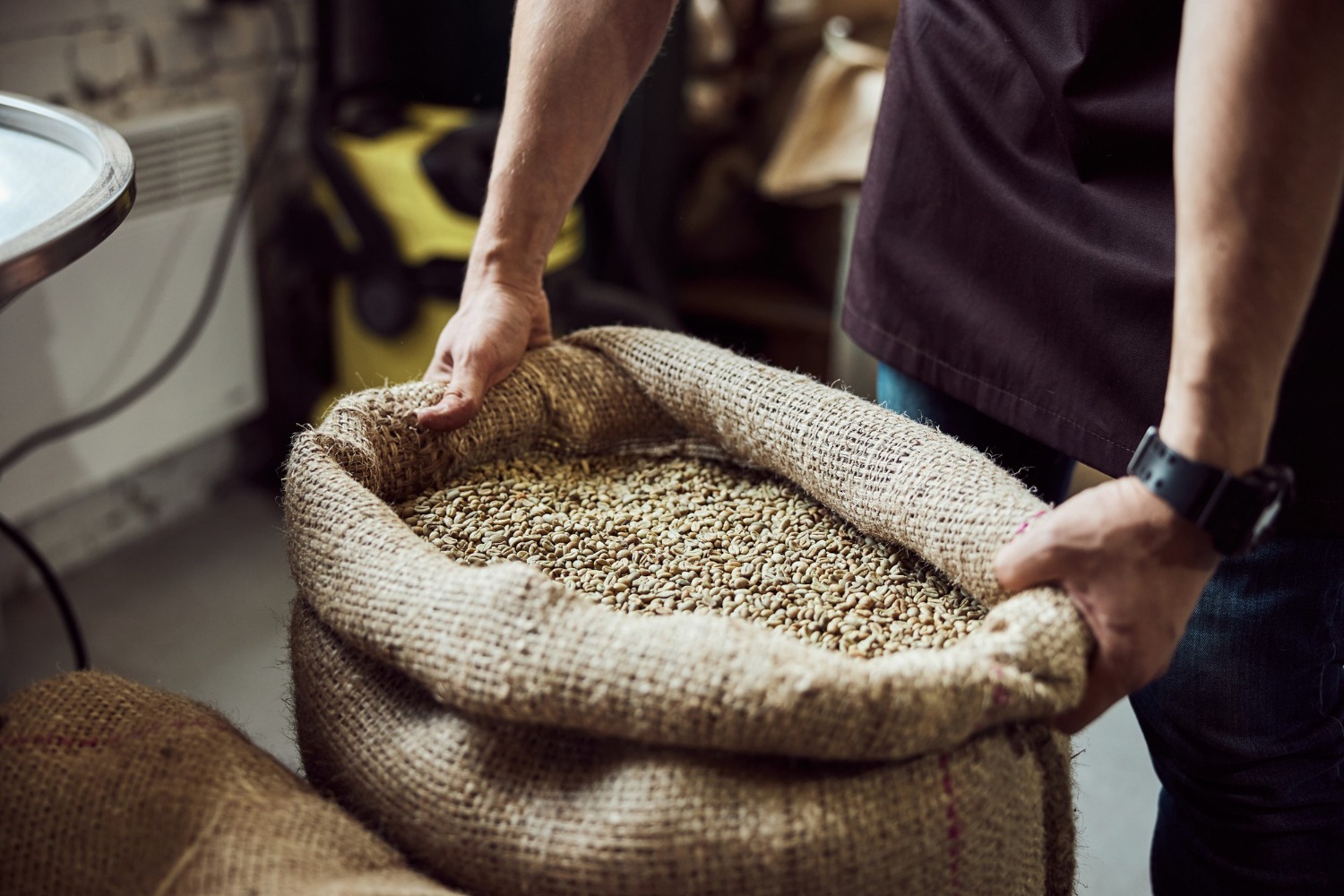
Roasted beans begin degrading as soon as they’re exposed to air and heat. If packaging can’t release gas or block oxygen effectively, bags may swell, split, or arrive tasting flat after only a few days in transit.
Green beans are more stable, but they come with different risks. Moisture exposure during shipping can lead to mould, and international shipments are more likely to face inspection if packaging appears compromised or poorly sealed.
Vacuum-sealed bags can work for small roasted batches, but any seal failure during transit allows oxygen in and accelerates flavour loss. Foil bags with one-way valves allow roasted coffee to release gas without letting air in, reducing the risk of burst bags and returns caused by damaged parcels.
Outer packaging matters just as much. Weak boxes or thin mailers increase the chance of crushed bags, particularly in courier networks where parcels are stacked, moved, and transferred multiple times.
A roaster in Melbourne, shipping weekly interstate subscription orders, experienced this issue firsthand. After switching from padded mailers to rigid boxes during the summer, customer complaints about swollen bags and flavour loss dropped within weeks. The coffee didn’t change, but the packaging did.
Clear labelling helps parcels move more predictably through courier systems. Including a roast date sets expectations and helps resolve freshness concerns if delays occur. Marking parcels as perishable encourages more careful handling, while simple handling instructions reduce the risk of boxes being crushed or stored incorrectly.
When packaging or labelling is unclear, the result is often slower delivery, damaged goods, or back-and-forth with customers and carriers. Making these choices with real shipping conditions in mind helps coffee arrive intact, on time, and tasting the way it should.
For roasters and retailers shipping within Australia, the main trade-off is usually between speed, cost, and freshness.
Same-day delivery is commonly used for metro shipments where timing matters, such as café restocks or local wholesale orders. This option suits short distances where beans can move from roaster to customer within hours, reducing the risk of quality loss.
Overnight shipping is often used for interstate or regional deliveries where next-day arrival is expected. It’s a practical option for online orders or subscription shipments that need to arrive quickly but don’t require same-day handling.
Standard shipping is better suited to non-urgent deliveries, larger batches, or wholesale orders where delivery timing is more flexible. While it’s usually more economical, it may not be suitable for customers who expect freshly roasted beans to arrive within a tight window.
When choosing between domestic shipping options, businesses should weigh order size, destination, customer expectations, and the maximum transit time beans can tolerate without compromising quality.
Shipping coffee beans overseas requires more preparation than domestic delivery, particularly around documentation and compliance. The level of complexity depends largely on whether you’re exporting roasted or green beans, as well as the destination country’s import rules.
For customs and biosecurity, roasted coffee beans generally face fewer restrictions, but they must still be declared accurately. Green coffee beans are treated as plant products and often require additional documentation, such as phytosanitary certificates, to meet biosecurity requirements. Exporters should confirm destination-specific rules before booking shipments to avoid delays or rejected consignments.
When choosing a delivery method, businesses typically decide between air freight and sea freight. Air freight is commonly used for smaller, higher-value shipments where delivery time matters, while sea freight is better suited to larger volumes where cost is the primary concern and longer transit times are acceptable.
Different regions may also have specific labelling or documentation expectations. For example, shipments to Europe often require clear country-of-origin information and accurate commercial invoices. Understanding these requirements upfront helps reduce the risk of customs delays.
For businesses shipping internationally on a regular basis, using a platform that allows carrier comparison and centralised document management can make it easier to manage compliance and delivery across multiple destinations.
Shipping costs are shaped by everyday decisions. For most coffee businesses, the biggest cost differences come from how parcels are packed, how often orders are dispatched, and which services are used for each shipment.
Couriers price parcels based on weight and volume. Boxes that are slightly larger than necessary can push shipments into higher pricing tiers, even when the service level stays the same. Using packaging that closely fits the product helps avoid unnecessary dimensional weight charges. For small retail orders, removing excess padding or unused space can reduce costs across every shipment.
Express services cost more, and they only make sense when speed protects freshness or prevents customer complaints. For non-urgent interstate deliveries, standard services often arrive within a similar timeframe at a lower rate. Reviewing carrier options by order type, rather than defaulting to one courier, helps surface pricing differences that are easy to miss.
Sending small batches every day means paying pickup and handling fees repeatedly. Fewer, larger dispatches can lower the cost per order, particularly for wholesale and subscription deliveries. Grouping orders by destination also reduces freight charges and packaging usage.
When multiple orders ship together, transport and handling costs are spread across more units. This method works especially well for subscription services and wholesale accounts, where volumes are predictable, and dispatch schedules can be planned in advance.
Small adjustments in packaging, service selection, and dispatch timing can significantly reduce shipping costs without changing your coffee or your pricing.
As coffee businesses grow, managing deliveries often becomes more complex. Roasters and retailers may be booking different couriers for local café restocks, interstate customer orders, and international shipments, each with different pricing, transit times, and documentation requirements.
Couriers & Freight solves this by giving businesses a single place to compare delivery options across multiple carriers. This makes it easier to choose different services depending on the order type, destination, and urgency, without changing systems or processes each time.
Rather than relying on one courier for every shipment, coffee businesses can adjust their delivery approach as order volumes change, whether that’s managing weekly subscription orders, sending wholesale consignments, or coordinating export shipments.
Compare delivery options and book your next coffee shipment through Couriers & Freight to manage domestic and international deliveries in one place.
Ship coffee orders to customers in Australia or overseas using consumer courier services with Couriers & Freight.
Get a Quote Now


MHP

No Surcharge*

$16.50
$14
$15.50
$0
$15.50
$14.75
$0
$0
$0
$0
MHP Large Item
No Surcharge*
$16.50
$75
$62
$62
$60.10
$14.75
$0
$0
$0
$0
Residential Pickup
No Surcharge*
$6
$0
$9
--
$9
$10.60
$0
$0
$0
$38.50
Reidential pick up 30-99kgs
No Surcharge*
$63
$0
$9
$0
$9
$74.15
$20
Won't carry
Won't carry
$38.50
Residential pick up 100kgs+
No Surcharge*
$198
$0
$9
$0
$9
$158.87
$50
Won't carry
Won't carry
$38.50
Residential Delivery up to 29kgs
No Surcharge*
$6
$0
$9
--
$9.00
$10.60
$0
$0
$0
$38.50
Residential Delivery up 30-99kgs
No Surcharge*
$63
$0
$9
$0
$9
$74.15
$20
Won't carry
Won't carry
$38.50
Residential Delivery 100kgs+
No Surcharge*
$198
$0
$9
--
$9
$158.57
$50
Won't carry
Won't carry
$38.50
Tail Lift Pick up 50-99kgs Sydney / Melbourne
No Surcharge*
$45
$50-$250
$88
$88
$88
$44.07
$120
Won't carry
Won't carry
$61.50
Tail Lift Pick up 100-299kgs Sydney / Melbourne
No Surcharge*
$85
$50-$250
$88
$88
$88
$44.07
$120
Won't carry
Won't carry
$61.50
Tail Lift Pick up 300-499kgs Sydney / Melbourne
No Surcharge*
$120
$50-$250
$88
$88
$88
$44.07
$120
Won't carry
Won't carry
$61.50
Tail Lift Pick up 500kgs + Sydney / Melbourne
No Surcharge*
$250
$50-$250
$88
$88
$88
$44.07
$120
Won't carry
Won't carry
$61.50
Tail Lift Delivery 50-99kgs Sydney / Melbourne
No Surcharge*
$45
$50-$250
$88
$88
$88
$44.07
$120
Won't carry
Won't carry
$61.50
Tail Lift Delivery 100-299kgs Sydney / Melbourne
No Surcharge*
$85
$50-$250
$88
$88
$88
$44.07
$120
Won't carry
Won't carry
$61.50
Tail Lift Delivery300-499kgs Sydney / Melbourne
No Surcharge*
$120
$50-$250
$88
$88
$88
$44.07
$120
Won't carry
Won't carry
$61.50
Tail Lift Delivery 500kgs + Sydney / Melbourne
No Surcharge*
$250
$50-$250
$88
$88
$88
$44.07
$120
Won't carry
Won't carry
$61.50
Dead weight over 32KGS carton freight
No Surcharge*
$16.50
$75
$70
$70
$70
$14.75
$0
Won't carry
Won't carry
$0
Oversize Surcharge 1.20 - 1.54
No Surcharge*
--
$0
$0
$0
$0
$5.40
$10
$15
Won't carry
$0
Oversize Surcharge 1.55 - 1.85
No Surcharge*
$17
$20
$0
$0
$0
$11.93
$10
$15
Won't carry
$0
Oversize Surcharge 1.86 - 2.20
No Surcharge*
$37
$40
$0
$0
$0
$11.93
$10
Won't carry
Won't carry
$0
Pallet Surcharge
No Surcharge*
--
$0
$0
$0
$0
$0
$0
Won't carry
Won't carry
$0
Hand Unload Fee Carton
No Surcharge*
--
$0
$70
$70
$70
$47
$0
Won't carry
Won't carry
$61.50
Western Australia Regional Surcharge
No Surcharge*
%10
$0
$0
$0
$0
$0
$0
$0
$0
$0
*Surcharges may apply to areas/deimensions not listed
**Prices correct of 16th September 2024

Click to start shipping in less than 60 seconds