
🎄 Festive Rush - Deliveries might take a bit longer. We appreciate your patience.
Festive Period 2025
Cut-Off Times

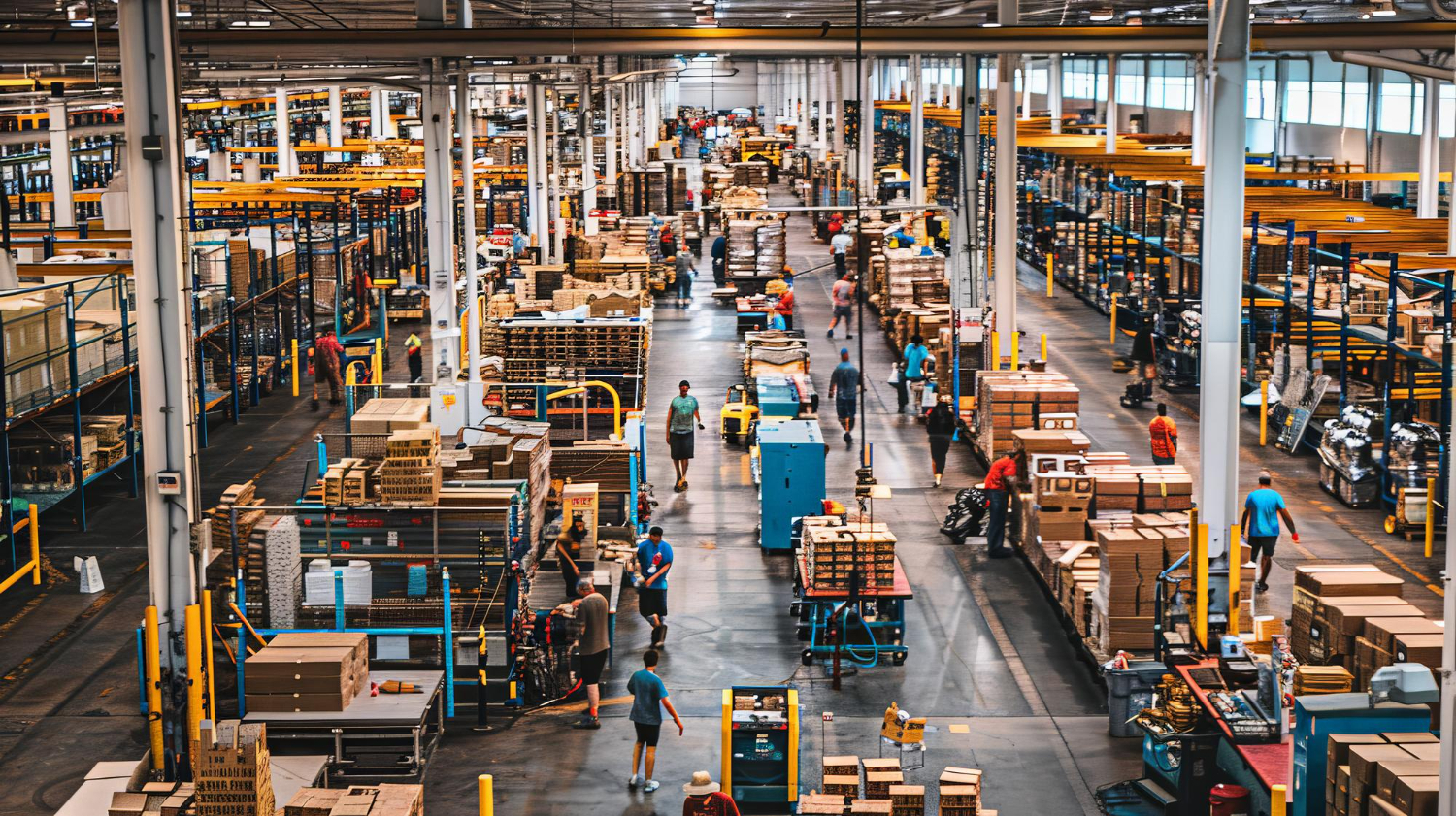
Knowing how much warehouse space you need before signing a lease is one of the most consequential decisions a product-based business will make. Lease too much, and you carry dead rent on unused space. Lease too little and operations break down as pallets spill into aisles and dispatch slows.
Australia's industrial vacancy rate was at 2.1% in Sydney and 1.4% in Perth in late 2024, which limits the ability to correct a poor decision quickly. This guide gives you a pallet-based calculation, so you leave with a number you can act on before committing to space.
Store your inventory and dispatch orders through Couriers & Freight's Australian fulfilment facilities.
Get a Quote NowTo see how this calculation compares against outsourcing, visit Couriers & Freight's warehouse and fulfilment service.
A square metre estimate misses buffer stock, staging space, and aisle clearance. A formula captures each requirement and produces a usable floor area figure.
Required floor area = ((Average pallets on hand × 1.25) + (Daily inbound pallets × 5) + (Daily outbound pallets × 2)) × 2.6m²
This formula structure is based on operational practice from James Maranis, Owner, Eastern Auto Paints. It accounts for buffer stock, inbound staging, and outbound dispatch.
"Required pallet positions = average pallets on hand times 1.25 buffer, plus inbound staging for 5 days and outbound for 2 days. Then convert to square metres using about 2.6 per pallet to allow for safe handling and aisle access. Peak demand is driven by order profile, not the calendar."
- James Maranis, Owner, Eastern Auto Paints

Peak demand follows the order profile rather than the calendar events. The 1.25 multiplier should reflect actual stock turn and supplier lead times.
A business that sizes space around assumed seasonal spikes risks holding excess space or running short when demand increases. Base the multiplier on replenishment cycles instead of calendar assumptions.
Once you calculate the required floor area, compare it to the available space. If the result exceeds 85% of usable capacity, the operation is already at risk of congestion and delays. Vertical stacking capacity also affects floor requirements. Facilities with higher clear height and racking reduce floor space needs.
Inventory storage typically occupies 50 to 60% of total warehouse space. Receiving and dispatch staging account for 15 to 20%. Industry benchmarks allocate one dock door per 10,000 square feet. Office and amenities must meet the Australian National Construction Code minimum of 10m² per person.
"In most cases, it is cheaper to handle fulfilment yourself, but as you scale, it becomes an operational burden. I found I was spending too much time on hiring and systems instead of growth. A 3PL lets you avoid that overhead and refocus on product and marketing."
- Feargus McConnell, CEO and Founder, Dr Ferg's
When the space calculation reveals a footprint that requires dedicated staff, racking investment, and compliance overhead, a managed Third-Party Logistics (3PL) provider becomes an operational decision rather than a cost measure.
Couriers & Freight’s warehouse and fulfilment service covers inventory receiving, storage, pick and pack, and dispatch through Australian fulfilment facilities. Businesses that do not want to manage that footprint can assess the 3PL model as a direct alternative.
This article supports two decisions: how to calculate warehouse space and when outsourcing is more practical. The key figures are 2.6m² per pallet position and a 1.25 buffer multiplier. Apply the formula, check it against the 85% utilisation ceiling, and add non-storage space to reach a complete floor area figure.
Book warehouse storage with Couriers & Freight based on your calculated floor area and pallet requirements.
Store your inventory and dispatch orders through Couriers & Freight's Australian fulfilment facilities.
Get a Quote Now


MHP

No Surcharge*

$16.50
$14
$15.50
$0
$15.50
$14.75
$0
$0
$0
$0
MHP Large Item
No Surcharge*
$16.50
$75
$62
$62
$60.10
$14.75
$0
$0
$0
$0
Residential Pickup
No Surcharge*
$6
$0
$9
--
$9
$10.60
$0
$0
$0
$38.50
Reidential pick up 30-99kgs
No Surcharge*
$63
$0
$9
$0
$9
$74.15
$20
Won't carry
Won't carry
$38.50
Residential pick up 100kgs+
No Surcharge*
$198
$0
$9
$0
$9
$158.87
$50
Won't carry
Won't carry
$38.50
Residential Delivery up to 29kgs
No Surcharge*
$6
$0
$9
--
$9.00
$10.60
$0
$0
$0
$38.50
Residential Delivery up 30-99kgs
No Surcharge*
$63
$0
$9
$0
$9
$74.15
$20
Won't carry
Won't carry
$38.50
Residential Delivery 100kgs+
No Surcharge*
$198
$0
$9
--
$9
$158.57
$50
Won't carry
Won't carry
$38.50
Tail Lift Pick up 50-99kgs Sydney / Melbourne
No Surcharge*
$45
$50-$250
$88
$88
$88
$44.07
$120
Won't carry
Won't carry
$61.50
Tail Lift Pick up 100-299kgs Sydney / Melbourne
No Surcharge*
$85
$50-$250
$88
$88
$88
$44.07
$120
Won't carry
Won't carry
$61.50
Tail Lift Pick up 300-499kgs Sydney / Melbourne
No Surcharge*
$120
$50-$250
$88
$88
$88
$44.07
$120
Won't carry
Won't carry
$61.50
Tail Lift Pick up 500kgs + Sydney / Melbourne
No Surcharge*
$250
$50-$250
$88
$88
$88
$44.07
$120
Won't carry
Won't carry
$61.50
Tail Lift Delivery 50-99kgs Sydney / Melbourne
No Surcharge*
$45
$50-$250
$88
$88
$88
$44.07
$120
Won't carry
Won't carry
$61.50
Tail Lift Delivery 100-299kgs Sydney / Melbourne
No Surcharge*
$85
$50-$250
$88
$88
$88
$44.07
$120
Won't carry
Won't carry
$61.50
Tail Lift Delivery300-499kgs Sydney / Melbourne
No Surcharge*
$120
$50-$250
$88
$88
$88
$44.07
$120
Won't carry
Won't carry
$61.50
Tail Lift Delivery 500kgs + Sydney / Melbourne
No Surcharge*
$250
$50-$250
$88
$88
$88
$44.07
$120
Won't carry
Won't carry
$61.50
Dead weight over 32KGS carton freight
No Surcharge*
$16.50
$75
$70
$70
$70
$14.75
$0
Won't carry
Won't carry
$0
Oversize Surcharge 1.20 - 1.54
No Surcharge*
--
$0
$0
$0
$0
$5.40
$10
$15
Won't carry
$0
Oversize Surcharge 1.55 - 1.85
No Surcharge*
$17
$20
$0
$0
$0
$11.93
$10
$15
Won't carry
$0
Oversize Surcharge 1.86 - 2.20
No Surcharge*
$37
$40
$0
$0
$0
$11.93
$10
Won't carry
Won't carry
$0
Pallet Surcharge
No Surcharge*
--
$0
$0
$0
$0
$0
$0
Won't carry
Won't carry
$0
Hand Unload Fee Carton
No Surcharge*
--
$0
$70
$70
$70
$47
$0
Won't carry
Won't carry
$61.50
Western Australia Regional Surcharge
No Surcharge*
%10
$0
$0
$0
$0
$0
$0
$0
$0
$0
*Surcharges may apply to areas/deimensions not listed
**Prices correct of 16th September 2024

Click to start shipping in less than 60 seconds