
🎄 Festive Rush - Deliveries might take a bit longer. We appreciate your patience.
Festive Period 2025
Cut-Off Times

Businesses that import activewear from China are supplying a market with consistent demand for fitness and athleisure products. Australia's gym apparel market recorded a compound annual growth rate (CAGR) of 4.29% between 2020 and 2024. As demand grows, Australian importers must manage MOQ requirements, product specifications, customs documentation, duty obligations, and freight planning to ensure stock arrives at a commercially viable landed cost.
Finding a manufacturer is only the first step. Activewear importers must also navigate freight planning, customs clearance, compliance obligations, and inventory management before goods can be sold in Australia.
Get a freight quote to ship activewear from China to Australia by sea or air.
Get a Quote NowOnce your supplier and order specifications are confirmed, compare sea freight and air freight options through Couriers & Freight to determine the most suitable shipping method for your order size and timeline.
The three main sourcing platforms each serve a different type of buyer. Alibaba lists OEM and ODM manufacturers set up for export, with English-language interfaces, trade assurance protections, and verified supplier tiers. 1688.com operates as a domestic Chinese wholesale platform where factory pricing is lower, but listings are in Mandarin, and most suppliers do not communicate directly with overseas buyers.
Using a sourcing agent is standard practice. Global Sources targets vetted exporters with a history of international trade and is used heavily by buyers seeking audited factories.
Manufacturing for activewear is concentrated in three provinces.
MOQ requirements for activewear manufacturers in China commonly range from 100 to 500 pieces per style and colour combination, according to sourcing references from Chinese apparel manufacturers and activewear suppliers. These quantities are generally spread across a full-size run rather than allocated to a single size.
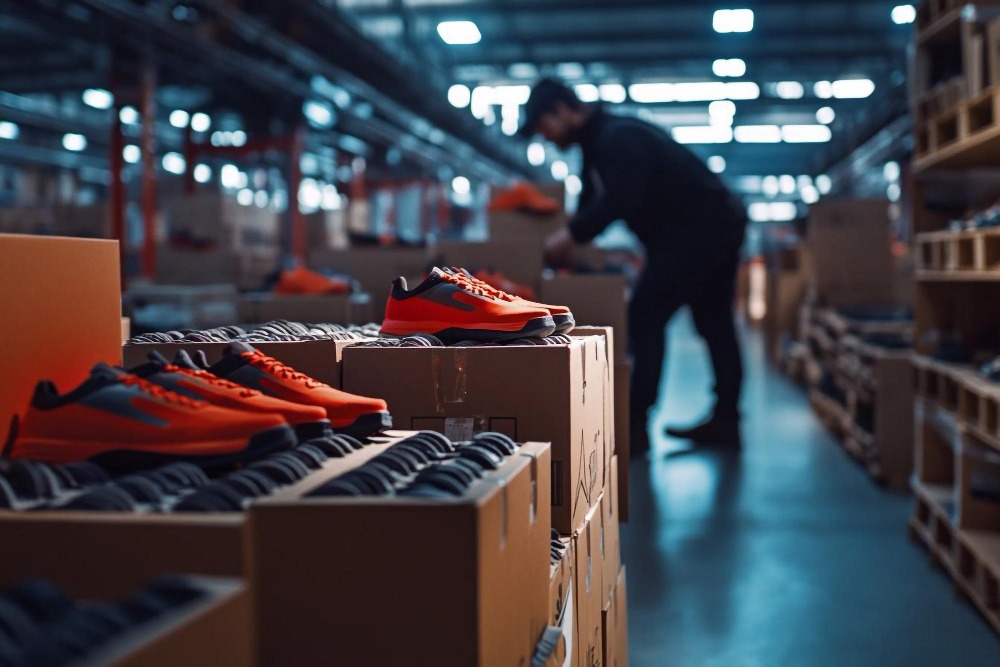
For example, a buyer ordering a 200-piece production run across XS to XL sizes may need to distribute stock across five sizes before freight costs are considered. This affects inventory planning, warehouse space, and initial cash flow requirements.
MOQ levels often increase when custom fabrics, specialised dyeing processes, or unique trims are required. Standard activewear fabrics and stock colourways typically attract lower minimums than fully customised products.
Couriers & Freight' Pro Tip: Buyers who plan to import activewear from China should confirm MOQ requirements before calculating landed costs and freight budgets.
A paid sample allows buyers to verify whether the finished garment matches the approved specification before committing to bulk production. For activewear, this includes assessing fabric stretch, seam integrity, fabric transparency, logo placement, waistband construction, and overall fit before manufacturing begins.
Skipping the sampling stage can result in production issues being identified only after the goods arrive in Australia. At that point, manufacturing costs, freight charges, customs fees, and GST have already been incurred.
Sample production for activewear typically takes 7 to 14 days. Many manufacturers charge a sample fee that is later credited against the bulk production order. Request at least one sample for fit testing and one retained sample for production reference.
Every product specification should be documented in writing before production begins. Businesses sourcing activewear from Chinese manufacturers should confirm fibre composition, GSM weight, stretch direction, colour standards, and certification requirements before approving manufacture.
For activewear, common specifications include:
Brands promoting recycled materials should also confirm certification standards such as the Global Recycled Standard (GRS).
Vague specifications increase the risk of receiving goods that do not match the intended product. Under Australian Consumer Law, importers remain responsible for product claims made to consumers. If a garment is marketed with specific performance characteristics, those claims must be supported by the product supplied.
Importers should also make sure their textile products comply with Australian labelling requirements and request testing documentation where necessary. Textile products sold in Australia should accurately disclose fibre composition and support any performance claims made to consumers. The Australian Competition and Consumer Commission ACCC provides a guide on hazardous aromatic amines derived from certain azo dyes in products that come into prolonged skin contact.
Because activewear is worn directly against the skin during physical activity, importers should request relevant testing documentation from suppliers before shipment.
Commercial activewear shipments entering Australia require a customs declaration supported by a commercial invoice, packing list, and either a Bill of Lading or Air Waybill. First-time importers often engage a licensed customs broker to manage tariff classification and customs entry requirements.
Most activewear products are classified within Chapter 61 of the Australian Customs Tariff Schedule, which covers knitted or crocheted apparel. Relevant headings may include HS 6104 for women's knitted garments and HS 6112 for tracksuits, sportswear, and swimwear.
The general customs duty rate for many textile and apparel products is 5%, although eligible Chinese-origin goods may qualify for preferential tariff treatment under the China-Australia Free Trade Agreement when supported by appropriate origin documentation. Activewear importers should confirm the applicable tariff classification and duty treatment before shipment.
Goods and Services Tax (GST) of 10% applies to the taxable importation value. Businesses registered for GST may generally claim eligible input tax credits through their Business Activity Statement (BAS).
Australian businesses sourcing activewear from Chinese manufacturers should also confirm compliance with applicable chemical safety requirements and retain supporting test reports where necessary.
First-time importers can also review Couriers & Freight's customs and freight resources before arranging their first shipment.
Freight mode comes down to order size and timeline.
For example, an activewear brand in Melbourne places a trial order of 300 to 400 units across multiple styles to test the Australian market. The shipment doesn't fill a 20-foot container, which makes LCL sea freight the more cost-effective option. Sharing container space with other cargo lowers freight costs while keeping access to commercial import volumes.
On the other end, a sports retailer in Sydney running low on stock ahead of EOFY sales needs replenishment fast. Air freight cuts transit time and helps avoid lost sales when timing matters more than cost. Businesses import activewear from China by air when stock is needed quickly before Click Frenzy, Boxing Day, or other peak retail periods.
As order volumes increase and begin filling a 20-foot or 40-foot container, full container load (FCL) ocean freight generally delivers a lower freight cost per unit and becomes the preferred option for repeat import programs.
Couriers & Freight provides access to LCL and FCL ocean freight from China for activewear importers scaling order volume. Air freight is available for replenishment orders that cannot wait for ocean transit times.
Get a sea freight quote for LCL or FCL shipments from China, or book air freight from China for urgent activewear orders.
Get a freight quote to ship activewear from China to Australia by sea or air.
Get a Quote Now


MHP

No Surcharge*

$16.50
$14
$15.50
$0
$15.50
$14.75
$0
$0
$0
$0
MHP Large Item
No Surcharge*
$16.50
$75
$62
$62
$60.10
$14.75
$0
$0
$0
$0
Residential Pickup
No Surcharge*
$6
$0
$9
--
$9
$10.60
$0
$0
$0
$38.50
Reidential pick up 30-99kgs
No Surcharge*
$63
$0
$9
$0
$9
$74.15
$20
Won't carry
Won't carry
$38.50
Residential pick up 100kgs+
No Surcharge*
$198
$0
$9
$0
$9
$158.87
$50
Won't carry
Won't carry
$38.50
Residential Delivery up to 29kgs
No Surcharge*
$6
$0
$9
--
$9.00
$10.60
$0
$0
$0
$38.50
Residential Delivery up 30-99kgs
No Surcharge*
$63
$0
$9
$0
$9
$74.15
$20
Won't carry
Won't carry
$38.50
Residential Delivery 100kgs+
No Surcharge*
$198
$0
$9
--
$9
$158.57
$50
Won't carry
Won't carry
$38.50
Tail Lift Pick up 50-99kgs Sydney / Melbourne
No Surcharge*
$45
$50-$250
$88
$88
$88
$44.07
$120
Won't carry
Won't carry
$61.50
Tail Lift Pick up 100-299kgs Sydney / Melbourne
No Surcharge*
$85
$50-$250
$88
$88
$88
$44.07
$120
Won't carry
Won't carry
$61.50
Tail Lift Pick up 300-499kgs Sydney / Melbourne
No Surcharge*
$120
$50-$250
$88
$88
$88
$44.07
$120
Won't carry
Won't carry
$61.50
Tail Lift Pick up 500kgs + Sydney / Melbourne
No Surcharge*
$250
$50-$250
$88
$88
$88
$44.07
$120
Won't carry
Won't carry
$61.50
Tail Lift Delivery 50-99kgs Sydney / Melbourne
No Surcharge*
$45
$50-$250
$88
$88
$88
$44.07
$120
Won't carry
Won't carry
$61.50
Tail Lift Delivery 100-299kgs Sydney / Melbourne
No Surcharge*
$85
$50-$250
$88
$88
$88
$44.07
$120
Won't carry
Won't carry
$61.50
Tail Lift Delivery300-499kgs Sydney / Melbourne
No Surcharge*
$120
$50-$250
$88
$88
$88
$44.07
$120
Won't carry
Won't carry
$61.50
Tail Lift Delivery 500kgs + Sydney / Melbourne
No Surcharge*
$250
$50-$250
$88
$88
$88
$44.07
$120
Won't carry
Won't carry
$61.50
Dead weight over 32KGS carton freight
No Surcharge*
$16.50
$75
$70
$70
$70
$14.75
$0
Won't carry
Won't carry
$0
Oversize Surcharge 1.20 - 1.54
No Surcharge*
--
$0
$0
$0
$0
$5.40
$10
$15
Won't carry
$0
Oversize Surcharge 1.55 - 1.85
No Surcharge*
$17
$20
$0
$0
$0
$11.93
$10
$15
Won't carry
$0
Oversize Surcharge 1.86 - 2.20
No Surcharge*
$37
$40
$0
$0
$0
$11.93
$10
Won't carry
Won't carry
$0
Pallet Surcharge
No Surcharge*
--
$0
$0
$0
$0
$0
$0
Won't carry
Won't carry
$0
Hand Unload Fee Carton
No Surcharge*
--
$0
$70
$70
$70
$47
$0
Won't carry
Won't carry
$61.50
Western Australia Regional Surcharge
No Surcharge*
%10
$0
$0
$0
$0
$0
$0
$0
$0
$0
*Surcharges may apply to areas/deimensions not listed
**Prices correct of 16th September 2024

Click to start shipping in less than 60 seconds