
🎄 Festive Rush - Deliveries might take a bit longer. We appreciate your patience.
Festive Period 2025
Cut-Off Times


Many businesses start looking at an Enterprise Resource Planning (ERP) system for freight when shipping delays, order mismatches, or manual processes start disrupting daily operations. Missed dispatch cut-offs, inventory that doesn’t line up with fulfilment, or separate systems for sales and logistics all slow decision-making.
In 2024, global ocean-freight schedule reliability averaged only 50 to 55%. This means that nearly half of container sailings experienced delays or disruptions, issues that flow directly into inventory planning and delivery commitments.
When these problems surface, businesses face a clear decision. They can invest in a full ERP to manage freight alongside finance and inventory, or adopt a dedicated freight platform focused on booking, tracking, and dispatch.
This guide helps Australian businesses assess whether an ERP for freight makes sense, or whether a freight management system is the more practical fit.
Compare carrier rates and book freight shipments through one platform.
Get a Quote NowBusinesses evaluating their freight setup can explore how the Couriers & Freight platform supports carrier booking, tracking, and dispatch without the complexity of a full ERP.
Enterprise Resource Planning (ERP) systems support freight and fulfilment by centralising the data that shipping decisions depend on, rather than managing freight execution itself. Their value lies in how inventory, orders, purchasing, and financial data connect across the business.
Inventory management within an ERP provides real-time stock visibility across locations and sales channels. For an Australian fashion retailer operating stores in Sydney, Melbourne, and Brisbane, this means knowing where stock is stored before allocating orders to warehouses or planning outbound freight. Accurate inventory data helps reduce overselling and improve restocking decisions tied to inbound freight.
ERP systems automate supplier orders and replenishment workflows. Importers bringing goods into Australia through ports such as Sydney or Fremantle often use ERP triggers to align purchase orders with expected container arrivals. This coordination supports better planning for inbound freight and warehouse intake, even though the ERP itself does not manage the shipment.
A unified order ledger consolidates sales from e‑commerce, wholesale, and physical stores. This allows logistics teams to prioritise fulfilment runs and batch orders efficiently. For example, a multi-channel outdoor goods brand can decide which orders ship together and which require separate carrier services based on location and urgency.
ERPs link freight costs with inventory value and cost of goods sold. By capturing freight spend alongside purchasing and sales data, ERPs support clearer margin analysis and profitability reporting without relying on manual reconciliation.
ERP adoption continues to grow as businesses look to centralise operations. The global ERP software market is projected to reach approximately $70.24 billion by 2025, reflecting strong uptake across retail, distribution, and manufacturing sectors, particularly through cloud-based systems.
However, ERPs have clear limits when it comes to day-to-day freight execution. Most do not handle carrier booking, rate comparison, label generation, real-time tracking, or parcel and pallet manifesting. These day-to-day shipping tasks are typically managed through freight management platforms or Transportation Management Systems (TMS) that integrate with ERP data rather than replace it.
You may be approaching the point where an ERP makes sense when freight and fulfilment issues stem from broader data and operational constraints, not just shipping tools alone.
Common indicators include:
Stock levels differ across warehouses, stores, or sales channels, making it difficult to allocate orders or plan freight without manual checks.
As volumes increase, teams spend more time reconciling orders, inventory, and invoices instead of managing dispatch and delivery priorities. Over 70% of organisations still rely on manual processes that cause inefficiencies and poor visibility.
Businesses operating across regional warehouses or interstate distribution hubs (for example, Sydney–Melbourne networks) struggle to align stock movement, inbound freight, and outbound fulfilment.
Weekly or monthly container arrivals increase the need to coordinate purchasing, inventory intake, and downstream shipping decisions in a single system.
Freight spend, delivery performance, and inventory metrics are compiled manually, slowing planning and making it harder to respond to supply chain issues.
If these signals happen together rather than in isolation, an ERP can help centralise data and support freight decisions across the wider business.
Freight management software is often the better fit when shipping execution is the main requirement, rather than enterprise-wide data control. These systems focus on booking carriers, managing dispatch, and tracking deliveries without the cost or setup time of a full ERP.
For many Australian SMEs, freight platforms are adopted first because they are faster to implement and easier to operate. Industry data supports this shift. The digital freight matching market generated approximately $1.54 billion in 2024, reflecting growing demand for flexible, freight-specific technology.
When freight needs centre on daily dispatch, carrier comparison, and shipment visibility, a dedicated freight platform can cover those workflows without introducing an ERP.
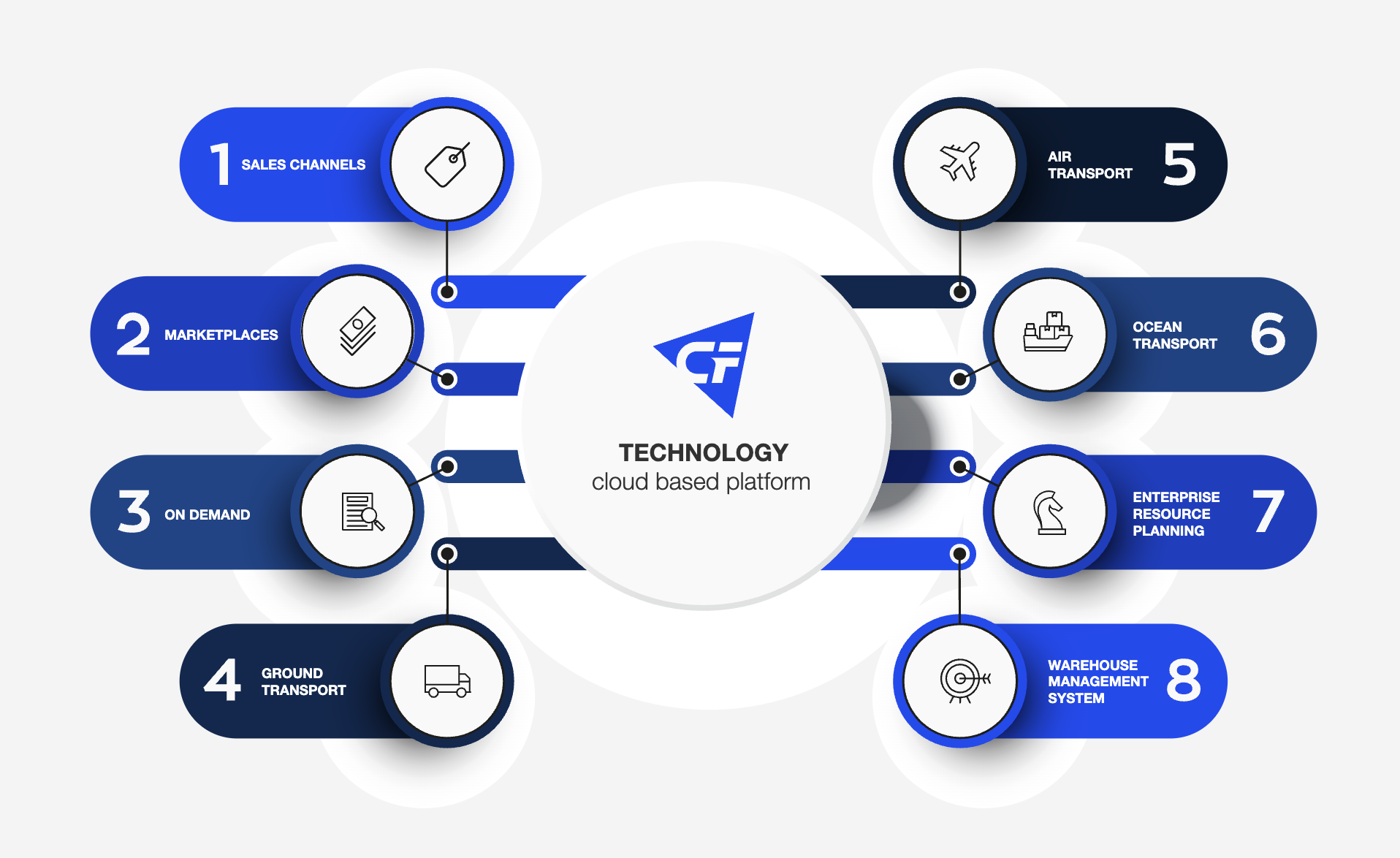
Many businesses eventually reach a point where neither an ERP nor a freight platform works well on its own. Instead, they operate together, each handling a distinct part of the workflow.
In these setups, the ERP acts as the system of record. It manages inventory, purchasing, orders, and financial data across the business. Freight software, by contrast, handles execution. It receives approved orders, books carriers, generates shipping documents, and tracks deliveries as they move.
This hybrid model is common among Australian e-commerce retailers, wholesalers, and importers with multiple warehouses or regular inbound freight. For example, an Australian e‑commerce retailer may consolidate inventory across Sydney and Perth warehouses in NetSuite or Microsoft Dynamics, then send orders to a freight platform for carrier selection, booking, and delivery updates. Similarly, B2B wholesalers or importers can keep financial and stock data in the ERP while using freight software to optimise pick-ups, rates, and scheduling.
Modern ERP and freight platforms support API or integrations that automate rate shopping, label printing, and tracking without manual entry.
For companies operating at this stage, the question shifts from “Do we need an ERP?” to “How do we connect freight execution to the systems we already use?”
Couriers & Freight is a dedicated freight management platform designed for businesses that need efficient shipping without the overhead of a full ERP. It works either on its own or alongside existing systems to handle the practical tasks that move orders out the door.
In a typical setup, Couriers & Freight receives orders from e-commerce platforms or internal systems, then manages carrier selection, booking, documentation, and tracking. This allows businesses to keep inventory, purchasing, and financial data in their ERP while running daily dispatch through a platform built specifically for freight.
The platform supports common operational needs such as:
Because these tasks are outside core accounting and inventory workflows, they can be handled without adding complexity to enterprise systems.
For businesses deciding how to manage freight alongside fulfilment, Couriers & Freight provides a practical way to connect shipping execution to existing operations without a full ERP rollout.
Get a quote to compare carriers and manage freight bookings through a single, centralised platform.
Compare carrier rates and book freight shipments through one platform.
Get a Quote Now


MHP

No Surcharge*

$16.50
$14
$15.50
$0
$15.50
$14.75
$0
$0
$0
$0
MHP Large Item
No Surcharge*
$16.50
$75
$62
$62
$60.10
$14.75
$0
$0
$0
$0
Residential Pickup
No Surcharge*
$6
$0
$9
--
$9
$10.60
$0
$0
$0
$38.50
Reidential pick up 30-99kgs
No Surcharge*
$63
$0
$9
$0
$9
$74.15
$20
Won't carry
Won't carry
$38.50
Residential pick up 100kgs+
No Surcharge*
$198
$0
$9
$0
$9
$158.87
$50
Won't carry
Won't carry
$38.50
Residential Delivery up to 29kgs
No Surcharge*
$6
$0
$9
--
$9.00
$10.60
$0
$0
$0
$38.50
Residential Delivery up 30-99kgs
No Surcharge*
$63
$0
$9
$0
$9
$74.15
$20
Won't carry
Won't carry
$38.50
Residential Delivery 100kgs+
No Surcharge*
$198
$0
$9
--
$9
$158.57
$50
Won't carry
Won't carry
$38.50
Tail Lift Pick up 50-99kgs Sydney / Melbourne
No Surcharge*
$45
$50-$250
$88
$88
$88
$44.07
$120
Won't carry
Won't carry
$61.50
Tail Lift Pick up 100-299kgs Sydney / Melbourne
No Surcharge*
$85
$50-$250
$88
$88
$88
$44.07
$120
Won't carry
Won't carry
$61.50
Tail Lift Pick up 300-499kgs Sydney / Melbourne
No Surcharge*
$120
$50-$250
$88
$88
$88
$44.07
$120
Won't carry
Won't carry
$61.50
Tail Lift Pick up 500kgs + Sydney / Melbourne
No Surcharge*
$250
$50-$250
$88
$88
$88
$44.07
$120
Won't carry
Won't carry
$61.50
Tail Lift Delivery 50-99kgs Sydney / Melbourne
No Surcharge*
$45
$50-$250
$88
$88
$88
$44.07
$120
Won't carry
Won't carry
$61.50
Tail Lift Delivery 100-299kgs Sydney / Melbourne
No Surcharge*
$85
$50-$250
$88
$88
$88
$44.07
$120
Won't carry
Won't carry
$61.50
Tail Lift Delivery300-499kgs Sydney / Melbourne
No Surcharge*
$120
$50-$250
$88
$88
$88
$44.07
$120
Won't carry
Won't carry
$61.50
Tail Lift Delivery 500kgs + Sydney / Melbourne
No Surcharge*
$250
$50-$250
$88
$88
$88
$44.07
$120
Won't carry
Won't carry
$61.50
Dead weight over 32KGS carton freight
No Surcharge*
$16.50
$75
$70
$70
$70
$14.75
$0
Won't carry
Won't carry
$0
Oversize Surcharge 1.20 - 1.54
No Surcharge*
--
$0
$0
$0
$0
$5.40
$10
$15
Won't carry
$0
Oversize Surcharge 1.55 - 1.85
No Surcharge*
$17
$20
$0
$0
$0
$11.93
$10
$15
Won't carry
$0
Oversize Surcharge 1.86 - 2.20
No Surcharge*
$37
$40
$0
$0
$0
$11.93
$10
Won't carry
Won't carry
$0
Pallet Surcharge
No Surcharge*
--
$0
$0
$0
$0
$0
$0
Won't carry
Won't carry
$0
Hand Unload Fee Carton
No Surcharge*
--
$0
$70
$70
$70
$47
$0
Won't carry
Won't carry
$61.50
Western Australia Regional Surcharge
No Surcharge*
%10
$0
$0
$0
$0
$0
$0
$0
$0
$0
*Surcharges may apply to areas/deimensions not listed
**Prices correct of 16th September 2024

Click to start shipping in less than 60 seconds