
🎄 Festive Rush - Deliveries might take a bit longer. We appreciate your patience.
Festive Period 2025
Cut-Off Times


If you are working out how to integrate a 3PL with your Shopify store, your order volume has likely reached the point where manual fulfilment is slowing down dispatch times and creating inventory inconsistencies across systems. Shopify notes that growing e-commerce merchants often adopt third-party fulfilment providers as order complexity increases and self-managed operations become harder to sustain.
This article covers the three integration methods, the setup steps for each, and the checks to complete before going live.
Book 3PL warehousing, pick-and-pack, and carrier dispatch for your Shopify store through Couriers & Freight's Australian fulfilment network.
Get a Quote NowAustralian Shopify sellers looking for local warehousing and carrier integration can connect their store through Couriers & Freight.
The best connection method depends on your order volume, warehouse setup, and whether you use any ERP or order management software. Smaller stores typically use apps or webhooks. While businesses with multiple warehouses or complex routing usually need middleware or a full API connection.
This is the most common approach. An app connects your 3PL's warehouse system to Shopify, so orders route automatically, and inventory levels and tracking numbers update in real time.
Without live inventory sync, Shopify can continue selling stock that has already been allocated at the warehouse. This leads to overselling, late dispatch, and unhappy customers.
Every product needs a unique SKU and barcode, and those values must match exactly between Shopify and the warehouse system. Mismatched SKUs are one of the most common causes of inventory errors.
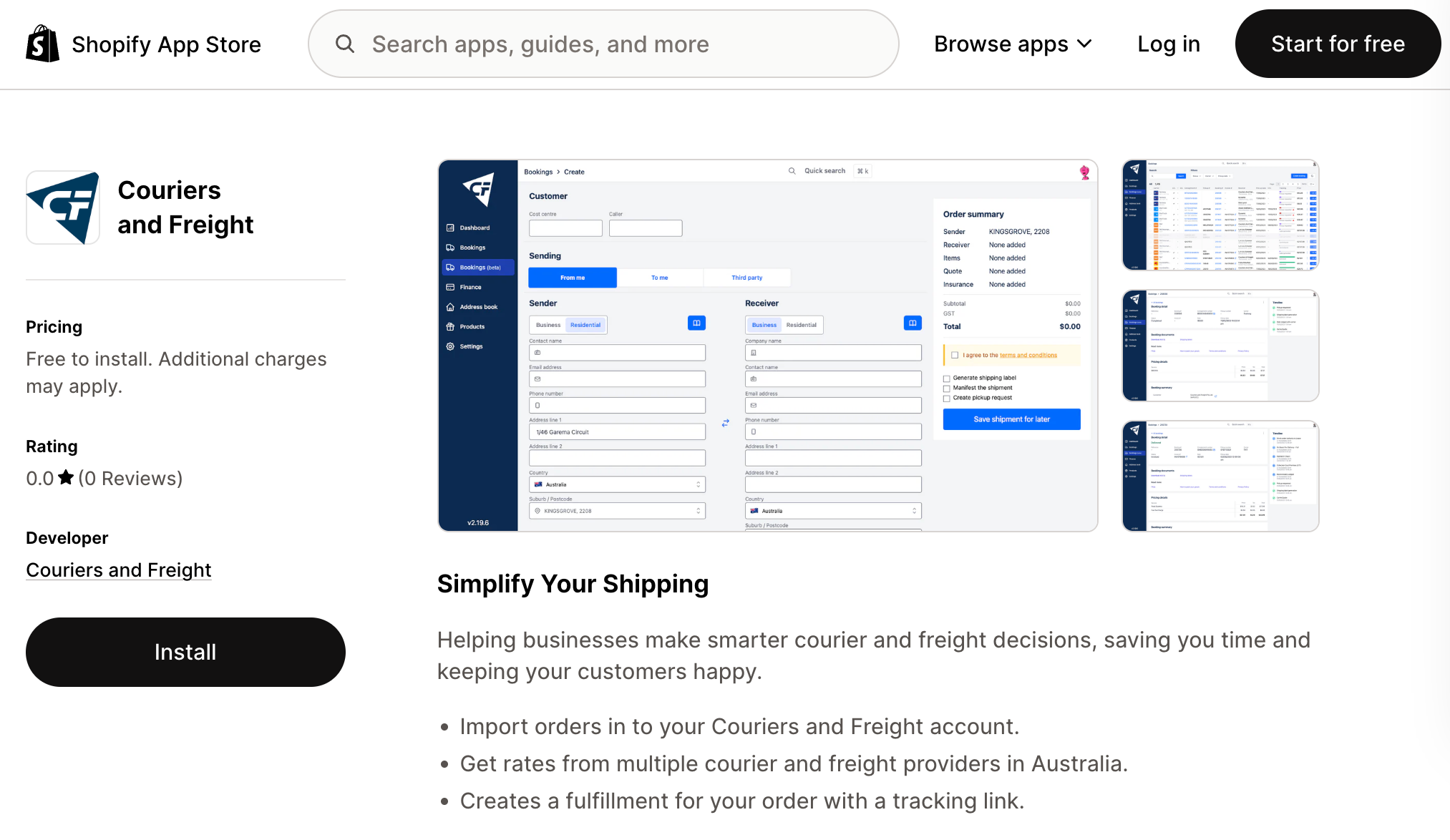
Most Australian Shopify sellers go with app-based integrations since they don't require a developer. Couriers & Freight offers a Shopify shipping app that connects directly to your store, and the platform handles order routing, inventory sync, and tracking from a single account.
Shopify's native fulfilment integrations allow fulfilment providers to connect directly through its backend infrastructure rather than through standalone apps. Inventory updates, order routing, and fulfilment statuses display within the admin interface.
This setup suits businesses that manage inventory, fulfilment, and shipping entirely through Shopify without external ERP systems.
Australian sellers using carrier-calculated shipping should verify whether their Shopify plan includes this feature before implementation. Checkout shipping rates may need to be entered manually if carrier-calculated shipping is unavailable, increasing the risk of undercharging delivery costs on shipments.
Shopify notes that third-party carrier-calculated shipping rates are only available on specific plans or as an add-on feature.

This is worth considering if you have outgrown a standard Shopify app but do not need a full middleware platform or ERP connection.
Shopify webhooks push order and inventory events directly to your 3PL's system the moment they occur. Inventory can then be adjusted when an order is placed, payment is confirmed, or an order is cancelled.
Because the data is pushed in real time rather than pulled on a schedule, there is no sync delay between Shopify and the warehouse management system. This matters for sellers with specific dispatch rules.
If your 3PL should only receive an order after payment is confirmed and fraud review is cleared, a webhook trigger can be configured to send the order at exactly that point rather than the moment it is placed.
Setup requires developer involvement. Your 3PL needs to provide a webhook endpoint, and the event triggers need to be configured correctly in Shopify. It is not a DIY method, but it is less infrastructure-heavy than a full iPaaS or middleware.
If your Shopify store fulfils orders from multiple warehouses, uses ERP software, or needs custom rules for routing orders, a standard Shopify app usually won't handle it.
The core problem is that most apps can't automatically decide which warehouse should handle a given order. Without smarter routing, you risk stock errors, split shipments, and delays.
The solution is connecting Shopify directly to your warehouse management system via API, or through an iPaaS (Integration-as-a-Platform-Service) platform. This setup is typical for businesses handling both wholesale and direct-to-consumer orders, especially when stock is split across locations or managed through an ERP.
Before committing to this approach, check:
Shopify's Fulfillment API documentation covers the technical side of how these connections are built.
Complete the following checks before activating live fulfilment. Most Shopify 3PL integration failures occur because inventory, shipping, or returns workflows were not validated during setup.
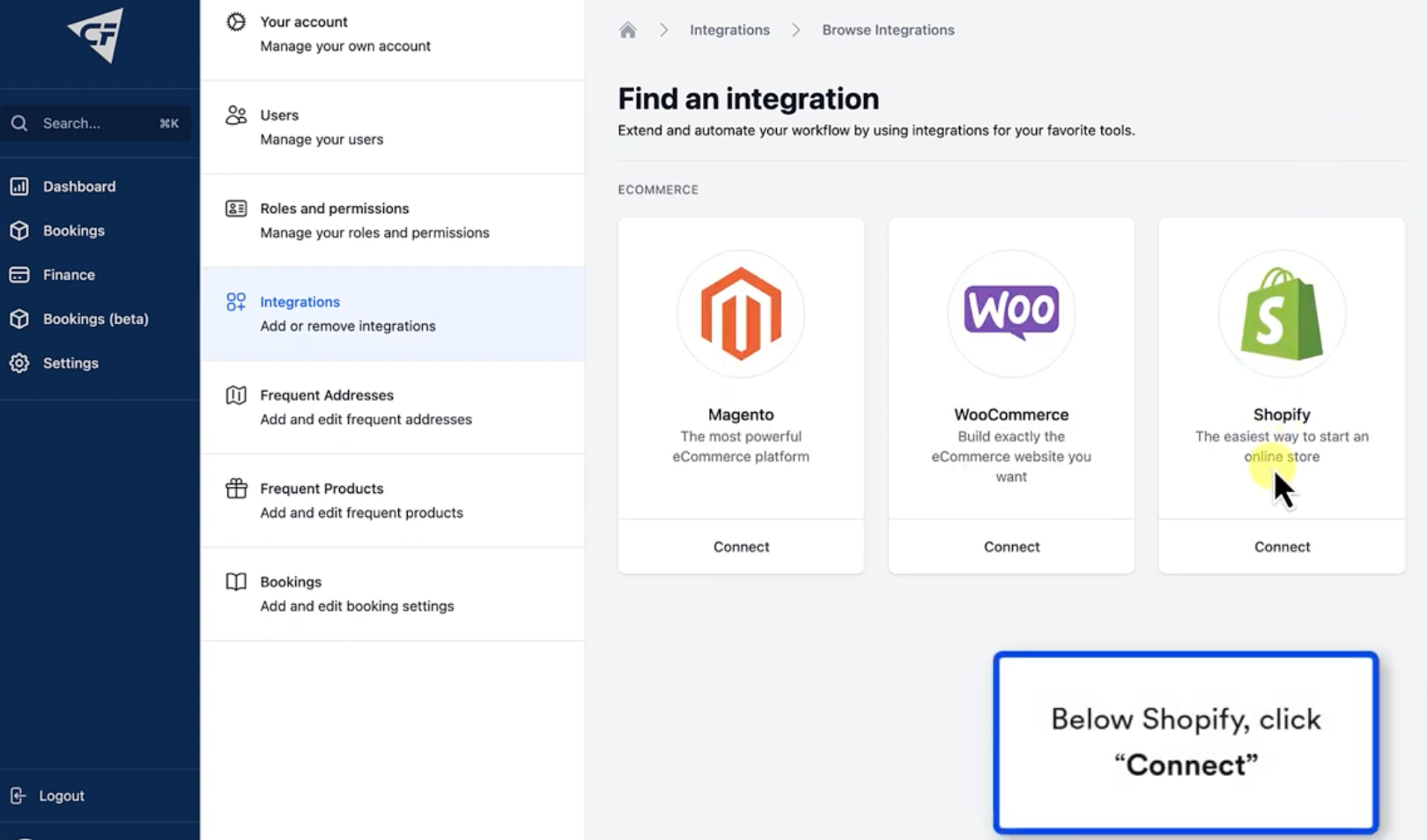
Couriers & Freight provides 3PL ecommerce fulfilment for Australian Shopify sellers, covering inbound receiving, warehousing, pick-and-pack, carrier dispatch, and shipment tracking through the platform. Orders placed through Shopify route directly into the warehouse workflow via the Couriers & Freight integration. Tracking information syncs back into the Shopify order record automatically after dispatch.
Shopify sellers using Couriers & Freight can access multiple carriers through one account without managing separate carrier contracts. The platform displays available carrier services, delivery estimates, and shipping rates at the point of booking.
Connect your store through the Couriers & Freight Shopify app to review the onboarding process and go live with fulfilment.
Book 3PL warehousing, pick-and-pack, and carrier dispatch for your Shopify store through Couriers & Freight's Australian fulfilment network.
Get a Quote Now


MHP

No Surcharge*

$16.50
$14
$15.50
$0
$15.50
$14.75
$0
$0
$0
$0
MHP Large Item
No Surcharge*
$16.50
$75
$62
$62
$60.10
$14.75
$0
$0
$0
$0
Residential Pickup
No Surcharge*
$6
$0
$9
--
$9
$10.60
$0
$0
$0
$38.50
Reidential pick up 30-99kgs
No Surcharge*
$63
$0
$9
$0
$9
$74.15
$20
Won't carry
Won't carry
$38.50
Residential pick up 100kgs+
No Surcharge*
$198
$0
$9
$0
$9
$158.87
$50
Won't carry
Won't carry
$38.50
Residential Delivery up to 29kgs
No Surcharge*
$6
$0
$9
--
$9.00
$10.60
$0
$0
$0
$38.50
Residential Delivery up 30-99kgs
No Surcharge*
$63
$0
$9
$0
$9
$74.15
$20
Won't carry
Won't carry
$38.50
Residential Delivery 100kgs+
No Surcharge*
$198
$0
$9
--
$9
$158.57
$50
Won't carry
Won't carry
$38.50
Tail Lift Pick up 50-99kgs Sydney / Melbourne
No Surcharge*
$45
$50-$250
$88
$88
$88
$44.07
$120
Won't carry
Won't carry
$61.50
Tail Lift Pick up 100-299kgs Sydney / Melbourne
No Surcharge*
$85
$50-$250
$88
$88
$88
$44.07
$120
Won't carry
Won't carry
$61.50
Tail Lift Pick up 300-499kgs Sydney / Melbourne
No Surcharge*
$120
$50-$250
$88
$88
$88
$44.07
$120
Won't carry
Won't carry
$61.50
Tail Lift Pick up 500kgs + Sydney / Melbourne
No Surcharge*
$250
$50-$250
$88
$88
$88
$44.07
$120
Won't carry
Won't carry
$61.50
Tail Lift Delivery 50-99kgs Sydney / Melbourne
No Surcharge*
$45
$50-$250
$88
$88
$88
$44.07
$120
Won't carry
Won't carry
$61.50
Tail Lift Delivery 100-299kgs Sydney / Melbourne
No Surcharge*
$85
$50-$250
$88
$88
$88
$44.07
$120
Won't carry
Won't carry
$61.50
Tail Lift Delivery300-499kgs Sydney / Melbourne
No Surcharge*
$120
$50-$250
$88
$88
$88
$44.07
$120
Won't carry
Won't carry
$61.50
Tail Lift Delivery 500kgs + Sydney / Melbourne
No Surcharge*
$250
$50-$250
$88
$88
$88
$44.07
$120
Won't carry
Won't carry
$61.50
Dead weight over 32KGS carton freight
No Surcharge*
$16.50
$75
$70
$70
$70
$14.75
$0
Won't carry
Won't carry
$0
Oversize Surcharge 1.20 - 1.54
No Surcharge*
--
$0
$0
$0
$0
$5.40
$10
$15
Won't carry
$0
Oversize Surcharge 1.55 - 1.85
No Surcharge*
$17
$20
$0
$0
$0
$11.93
$10
$15
Won't carry
$0
Oversize Surcharge 1.86 - 2.20
No Surcharge*
$37
$40
$0
$0
$0
$11.93
$10
Won't carry
Won't carry
$0
Pallet Surcharge
No Surcharge*
--
$0
$0
$0
$0
$0
$0
Won't carry
Won't carry
$0
Hand Unload Fee Carton
No Surcharge*
--
$0
$70
$70
$70
$47
$0
Won't carry
Won't carry
$61.50
Western Australia Regional Surcharge
No Surcharge*
%10
$0
$0
$0
$0
$0
$0
$0
$0
$0
*Surcharges may apply to areas/deimensions not listed
**Prices correct of 16th September 2024

Click to start shipping in less than 60 seconds